
Principal Investigator: Kristy Arbogast, PhD, Children’s Hospital of Philadelphia
Below is an executive summary of this line of research. Please note that each summary describes results and interpretation that may not be final. Final interpretation of results will be in the peer-reviewed literature.
2011-2012
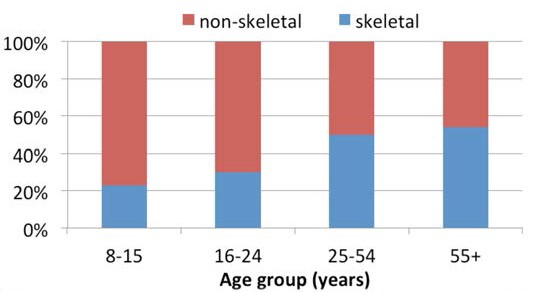
In this second phase of the project, researchers explored thoracic injuries and why they occurred in optimally restrained rear-seated children and adults to understand if preteens and adolescents sustain different types of injuries in crashes. Using data from the Crash Investigation Research and Engineering Network (CIREN), the researchers examined 20 frontal crash cases involving rear-seated, optimally restrained occupants ranging in age from 8 to 55+ years with AIS2+ thoracic injuries.
Six of the seven 8- to 15-year-olds sustained lung injuries, including collapsed lung (pneumothorax) and bruised lung (pulmonary contusion). Only three of the seven sustained a skeletal (sternum or rib) fracture, with only one of the three involving multiple ribs bilaterally. In contrast, four of the five 16- to 24-year-olds sustained at least one rib fracture, with most multiple and bilateral. Although the adults, ages 25 years and older, were predominantly involved in minor crashes, they all suffered complex rib fractures, with seven of the eight involving multiple ribs and half bilaterally. Belt compression – either from the shoulder belt or the lap belt – was identified as the primary cause of these injuries. These findings have implications for age-based thoracic injury criteria suggesting that different metrics may be needed for different age groups.
2010-2011
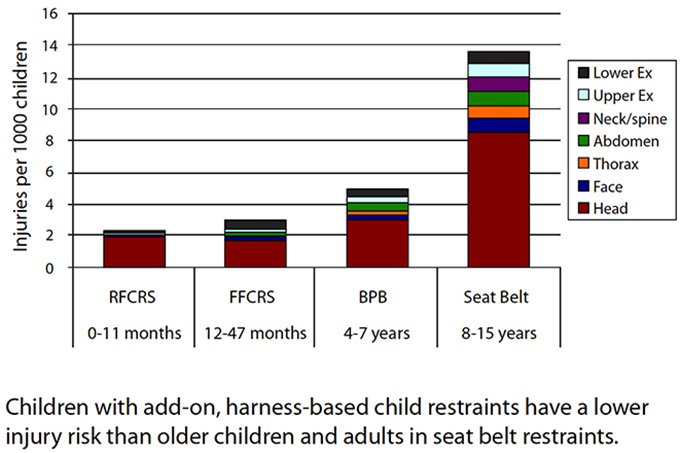
The first year of this project quantified the injury and fatality risk for both children and adults who are optimally restrained. Researchers found an elevated injury risk experienced by 8- to 12-year-old passengers that followed best practice recommendations for seat belt restraint as compared to the risk experienced by younger children. Adult injury risk in crashes varied by whether a child occupant was present due to differences in key vehicle and crash characteristics when adults drive alone or with child occupants.
Co-investigators
Caitlin Locey, BS and Mark Zonfrillo, MD, MSCE, Children’s Hospital of Philadelphia
IAB Mentors
J.T. Wang and Julie Kleinert, General Motors Holdings LLC; Rodney Rudd, National Highway Traffic Safety Administration; Schuyler St. Lawrence, TK Holdings (Takata Corp.).
Publication References