
Principal Investigator: Yun Seok Kang, PhD,Ohio State University
Side impacts are the second most frequent type of collision and can cause serious head, neck, and chest injuries to pediatric occupants. Efforts have been made by child restraint system (CRS) manufacturers to improve the effectiveness of CRS in side impacts, and various methods of attaching the CRS to the vehicle structure have been developed and validated. The Lower Anchors and Tethers for Children (LATCH) system standardizes the method to attach CRS to vehicles without using a seat belt in the US. The top tether is a well-known safety tool that improves the fit of CRS to vehicles, yet its effectiveness on the angular kinematics of the CRS and occupant has not been well documented in side impacts. Therefore, the objectives of the study are to investigate the effectiveness of the top tether in side impacts by considering the angular kinematics of the CRS and ATD, and to find the relationship between the angular kinematics of the CRS and the injury measures of the ATD.
Principal Investigator: Yun Seok Kang, PhD,Ohio State University
Below is an executive summary of this project. Please note that this summary describes results and interpretation that may not be final. Final interpretation of results will be in the peer-reviewed literature
Year 2: 2014 - 2015
The traditional method of attaching child restraint systems (CRS) to vehicle seats has been with an adult seat belt; however, studies have shown this method has resulted in frequent child restraint misuse, such as loose fitting and/or incorrect routing of the seat belt. In response, Lower Anchors and Tethers for Children (LATCH) was developed as a standardized method of attaching CRS to vehicle seats. The top tether is an important component of the LATCH system as it offers an additional attachment for a forward-facing CRS (FF CRS) to the vehicle seat or structure.
The Federal Motor Vehicle Safety Standard (FMVSS) No. 225 evaluates the strength of the top tether anchor, in conjunction with the lower anchors, during a quasi-static loading test. A weakness to this loading evaluation is that the dynamic conditions of a motor vehicle crash are not taken into account, and the top tether anchor is not evaluated independently from the lower anchors. The study aimed to further understand the dynamic loads experienced at the top tether anchor and the effect of various other parameters on these loads.
A finite element (FE) sled test environment simulating frontal crashes (conducted at 48 kilometers per hour) was constructed utilizing the FMVSS No. 213 test bench, a FF CRS, and a Hybrid III 6-year-old anthropomorphic test device (ATD), or crash test dummy. The CRS was secured to the bench with the flexible LATCH system, and LATCH anchor loads and ATD kinematics were recorded for each simulation. A parametric study was performed with varied top tether anchor location, CRS, and bench seat foam stiffness. Four top tether anchor locations, two CRS, and three seat foams were featured, resulting in a total of 24 simulation scenarios. Two additional parametric studies were performed observing the effect of top tether angle and top tether anchor location offsets on top tether anchor loads.
Top tether peak loads varied by top tether anchor locations as follows (ordered from highest to lowest peak loads): 1) roof, 2) shelf, 3) floor, 4) seatback. This ordering held true regardless of the seat foam stiffness and CRS used in the simulation. Across anchor locations, the top tether angle determined the amount of CRS rotation, which affected the amount of top tether/seatback interaction and CRS/seat pan interaction. Additionally, there was not a strong correlation between top tether loads and ATD head kinematics. The results of this study provide a valuable foundation for vehicle and CRS manufacturers to utilize in optimizing the LATCH system.
Year 2: 2013 - 2014
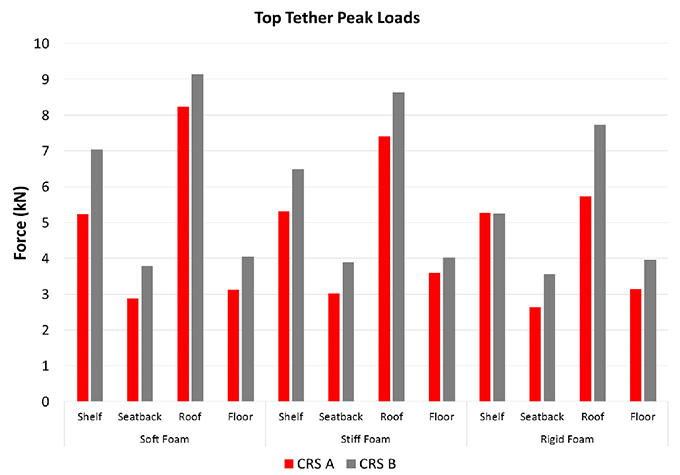
The data obtained in this study will provide an idea of the dynamic strength of LATCH anchorages with the new NHTSA requirements, when considering different locations of the anchorages (especially tether anchor locations) and different CRS uses (i.e. different weights). Results from this study will allow CRS engineers to optimally design CRSs and increase the safety of a child in a child restraint using the LATCH system.
This project is currently ongoing. Findings will be published here when the project is complete.
Students
Jordan Majstorovic, BS, The Ohio State University
IAB Mentors
Keith Nagelski, Britax Child Safety, Inc; Michelle Tsai, Consumer Reports; Terry Emerson, Dorel Juvenile Group; Eric Dahle, Evenflo Company Inc.; Audrey Eagle, FCA US LLC; Julie Kleinert, General Motors Holdings LLC; Mark La Plante, Graco Children’s Products Inc.